


How VAIRified Ratings Work (and Why They Matter)

Why Ratings Matter in the First Place
A rating is supposed to help players find fair competition.
When ratings are useful, open play runs smoother, events seed better, and players can find opponents and partners at the right level.
But not every rating is built for the same purpose.
Some ratings are best used as a starting point. Others are built to provide a more verified and trusted picture of skill. Problems usually show up when a basic rating is expected to do more than it was designed to do.
Where Problems Start
A starting-point rating can be useful for getting players into the system and building a baseline over time.
But when clubs, tournaments, or players rely too heavily on estimated or outcome-based ratings alone, gaps can start to show. A player's win-loss record does not always reflect how they actually play, and a self-selected starting point is not the same thing as a verified skill assessment.
That is where issues like skill-mismatched open play, uneven competition, and sandbagging can begin to show up.
When Winning Costs You Rating Points
Here's a scenario playing out at tournaments right now: a player battles through a bracket, wins gold, and checks their rating the next day, only to see it went down.
They won. Every match. And their rating dropped.
This isn't a glitch. It's how outcome-based algorithms work. Because these systems estimate skill from scores and point margins, a "narrow" win against a lower-rated opponent can be treated as under-performance, even in a gold medal match, even when the opponent played the game of their life. The algorithm doesn't know you were grinding out a final against a scrappy team. It just sees 11-9 and adjusts accordingly.
Ask around at any tournament venue and you'll hear the frustration firsthand. When winning gold can hurt your rating, players stop trusting the number. And a rating nobody trusts isn't doing its job.
Three Problems This Creates
- Skill-mismatched open play
For club directors and organizers, inaccurate or incomplete ratings create daily problems.
Skill-mismatched open play is one of the most common complaints. Games feel uneven. Players get frustrated. Organizers have to step in and manage groupings manually.
This is not an occasional issue. It happens multiple times per week at many clubs, especially at 4.0+ skill levels where the gaps become more obvious and more frustrating. - Sandbagging
Sandbagging is when a player carries an artificially low rating to compete in easier divisions.
This is mostly a tournament problem. A player with real skill plays down a level to have better odds of winning, which undermines fair competition for everyone else in that bracket.
While sandbagging does not happen as frequently as skill-mismatched open play, it creates real damage to competitive integrity when it does occur. - Ratings that punish the wrong things
Outcome-based systems don't just miss skill, they can actively misrepresent it. Win by "too little" and your rating suffers. Lose a close match against elite competition, arguably a sign you're improving, and the number moves against you anyway. Players learn the rating responds to the math of the scoreboard, not the quality of their play.
That creates a strange incentive structure: players managing their ratings instead of just competing. Some avoid certain matchups. Some run up scores on weaker opponents. None of that has anything to do with getting better at pickleball.
All three problems come back to the same root issue: a rating that does not fully reflect actual skill.
How the Evaluation Works
The fix for all of this starts with something surprisingly simple: instead of asking an algorithm to guess your starting skill level, have a trained human verify it.
That's the core flaw in outcome-based systems, they're doing math on top of a guess. If your starting rating is wrong (and self-assessed or estimated ratings often are), every adjustment after that is built on a bad foundation. The algorithm isn't broken so much as it was never given the truth to begin with.
Getting VAIRified is a straightforward process.
You book a session for $59 and meet a Certified Rater in person, or you submit video of your gameplay if there isn't a rater near you. Video submissions need a minimum of three recorded games so the rater has enough to evaluate.
Either way, the rater is watching you play real games. Not drills, not a skills test. Actual competitive play.
As you play, the rater scores your game against a structured 41-point checklist. That checklist is what makes the evaluation consistent and repeatable. Two different raters watching the same player are working from the same criteria, so the rating isn't a gut call or a one-time impression.
When the evaluation is complete, you receive your VAIRified rating along with general feedback on where your game can improve. That rating is verified, meaning it's backed by direct human observation. It's a number a tournament director can seed with and a club can group by.
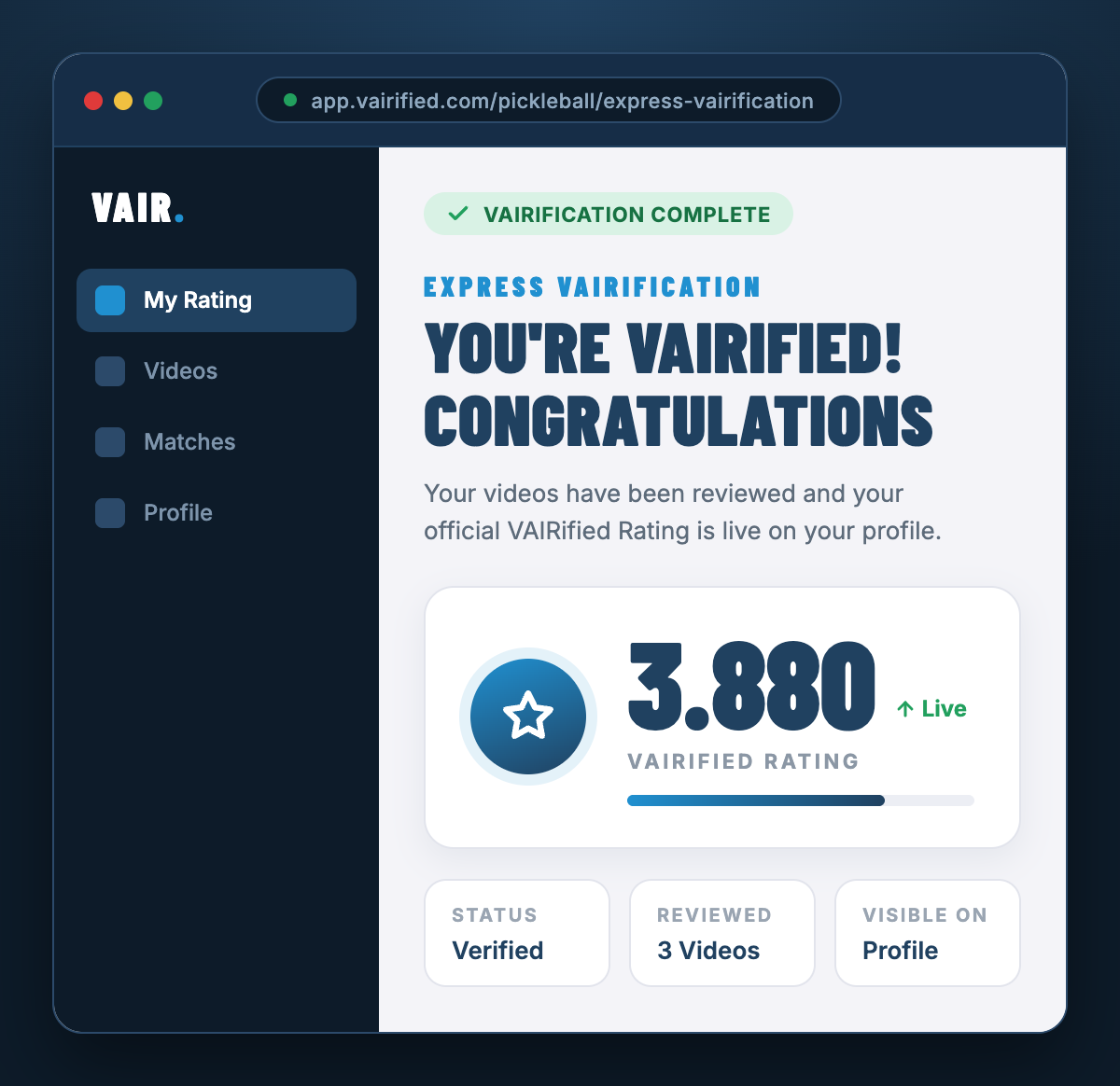
What Happens After You're VAIRified
Your evaluation happens once, and it gives you something no algorithm can: a verified baseline grounded in how you actually play.
From there, your rating does move with match results, but with one critical safeguard: games only count toward your VAIRified rating when every player on the court is also VAIRified. Play against unverified opponents and those games simply count toward your rec rating instead.
That means your VAIRified rating lives in a closed, verified ecosystem. No inflated numbers feeding into your matches. No sandbaggers polluting the pool. When your rating moves, it moves based on results against players whose skill levels are actually known, which is the only condition under which match results mean anything at all.
Outcome-based math isn't the enemy. Outcome-based math built on guesses is. Start from truth, keep the pool verified, and the number stays trustworthy.
Who This Helps
- Players
Players get a more verified understanding of their skill level and a clearer picture of how they actually play. - Clubs and Organizers
Clubs and organizers get a more trusted rating they can use for grouping, seeding, and creating fairer competition. - The Broader Community
When more players have ratings that better reflect actual skill, open play improves, events run smoother, and competition becomes more trustworthy overall.
The Simple Version
The free rating gives players a place to start.
The VAIRified rating is the deeper, more trusted option for players and clubs that need a more verified picture of skill.
And if you've ever won a match and watched your rating go down, you already understand why this matters.
For fairer open play, better competition, and more confidence in what a rating actually means, that difference matters.
Frequently asked questions
What is a VAIRified rating?
A VAIRified rating is VAIR's human-verified skill rating. A certified rater evaluates real gameplay against a structured 41-point checklist, rather than relying on match outcomes or self-assessment alone.
How is a VAIRified rating different from a starting-point rating?
A starting-point rating adjusts over time based on match results. A VAIRified rating is based on direct observation of gameplay by a certified rater, making it a verified rating rather than an estimated one.
What is sandbagging, and how does VAIR address it?
Sandbagging is when a player keeps an artificially low rating to compete in easier divisions. Because a VAIRified rating is based on observed skill rather than self-reported results, it creates a more accurate picture that's harder to game.